noisers#
Provides multiple Noisers.
- class AdditiveNoiser(distribution: Distribution[float])#
Bases:
NoiserThe AdditiveNoiser adds a randomly generated number to elements individually.
The number is generated using a given Distribution.
- distribution#
A distribution to generate random noise.
Inits AdditiveNoiser with the provided params.
- Parameters:
distribution – A distribution to generate random noise.
- noisify(signal: DataFrame) DataFrame#
Applies noise to the provided signal.
- Parameters:
signal – The input data.
- Returns:
pd.DataFrame
- class AdjustingMeanNoiser(weight: Distribution[float])#
Bases:
NoiserThe AdjustingMeanNoiser adjusts every value to the mean it’s column.
Does a linear interpolation for each cell between it’s value and it’s columns mean.
- With c_{i;j} being an arbitrary cell in column j and m(j)
being the mean of the column j, the following equation holds.
\[c_{i;j} = c_{i_j} + weight * (m(j) + c_{i;j})\]- weight#
Weight of the mean in the linear interpolation.
Example
>>> import pandas as pd
>>> from simba_ml.simulation import distributions
>>> from simba_ml.simulation.noisers.                adjusting_mean_noiser import AdjustingMeanNoiser
>>> clean_signal = pd.DataFrame([0, 10, 50])
>>> clean_signal
    0
0   0
1  10
2  50
>>> noisers = AdjustingMeanNoiser(distributions.Constant(0.5))
>>> noisers.noisify(clean_signal)
    0
0  10
1  15
2  35
>>> noisers = AdjustingMeanNoiser(distributions.Constant(0.2))
>>> noisers.noisify(clean_signal)
    0
0   4
1  12
2  44
Inits the AdjustingMeanNoiser.
- Parameters:
weight – Interpolation Factor. When weight is 1, then the output equals the mean of the column. If weight is 0.5 the output equals the mean of the column’s mean and the cell’s value.
- noisify(signal: DataFrame) DataFrame#
Applies noise to the provided signal.
- Parameters:
signal – The input data.
- Returns:
pd.DataFrame
- class ColumnNoiser(noisers: dict[str, simba_ml.simulation.noisers.noiser.Noiser])#
Bases:
NoiserThe ColumnNoiser applies a different Noiser to every column of the signal.
Columns without a provided Noiser will be skipped.
- noisers#
A dictionary containing the column names as keys and the corresponding Noiser as values.
Example
>>> import pandas as pd
>>> from simba_ml.simulation import distributions
>>> from simba_ml.simulation import noisers
>>> clean_signal = pd.DataFrame.from_dict({
...     "A": [75, 52, 68],
...     "B": [33, 96, 64],
...     "C": [57, 5, 13],
...     "D": [65, 4, 51],})
>>> clean_signal
    A   B   C   D
0  75  33  57  65
1  52  96   5   4
2  68  64  13  51
>>> col_noisers = {
...     "A": noisers.AdditiveNoiser(distributions.Constant(2)),
...     "B": noisers.MultiplicativeNoiser(distributions.Constant(2)),
...     "D": noisers.NoNoiser()}
>>> noiser = noisers.ColumnNoiser(col_noisers)
>>> noiser.noisify(clean_signal)
    A    B   C   D
0  77   66  57  65
1  54  192   5   4
2  70  128  13  51
Inits ColumnNoiser with the provided params.
- Parameters:
noisers – A dictionary containing the column names as keys and the corresponding Noiser as values.
- noisify(signal: DataFrame) DataFrame#
Applies noise to each column individually.
- Parameters:
signal – The input data.
- Returns:
pd.DataFrame
- class ElasticNoiser(k: Distribution[float], invert: bool = False, exponential: bool = False)#
Bases:
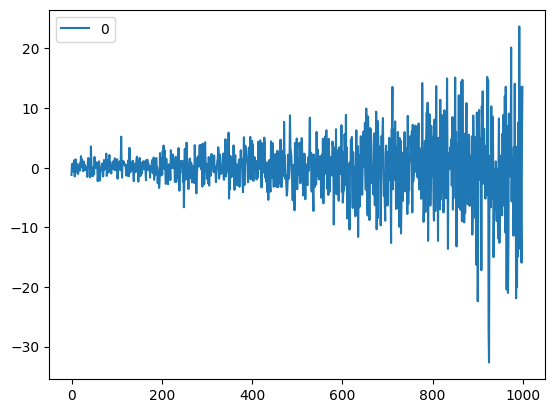
NoiserThe ElasticNoiser applies noise elastically.
Noise is added randomly at every point using a normal distributions where the variance increases with t.
- k#
maximal variance of the normal distributions
- invert#
If True, noise is added at the beggining of the curve.
- exponential#
If True, uses exponentially increasing noise. If invert = True, exponentially decreasing.
Inits ElasticNoiser with the provided params.
- Parameters:
k – maximal variance of the normal distributions
invert – If True, noise is added at the beggining of the curve.
exponential – If True, uses exponentially increasing noise. If invert = True, exponentially decreasing.
- noisify(signal: DataFrame) DataFrame#
Applies noise to the provided signal.
Applies random gaussian noise with increasing or decreasing variance over time to the signal.
- Parameters:
signal – The input data.
- Returns:
pd.DataFrame
Example
>>> import pandas as pd
>>> from simba_ml.simulation import distributions
>>> from simba_ml.simulation.noisers.elastic_noiser import ElasticNoiser
>>> series = [[0]] * 1000
>>> df = pd.DataFrame(series)
>>> df.head()
   0
0  0
1  0
2  0
3  0
4  0
>>> noisers = ElasticNoiser(distributions.Constant(10))
>>> noisers.noisify(df).plot()
- class MultiNoiser(noisers: list[simba_ml.simulation.noisers.noiser.Noiser])#
Bases:
NoiserApplies one randomly selected Noiser to add noise to an input signal.
- noisers#
A list of Noiser to choose from.
Inits MultiNoiser with the provided params.
- Parameters:
noisers – A list of Noiser to choose from.
- noisify(signal: DataFrame) DataFrame#
Applies noise to the provided signal.
- Parameters:
signal – The input data.
- Returns:
The noised signal.
- class MultiplicativeNoiser(distribution: Distribution[float])#
Bases:
NoiserMultiplies each element individually with a randomly generated number.
The number is generated using a selected Distribution.
- distribution#
A distribution to generate random noise.
Inits MultiplicativeNoiser with the provided params.
- Parameters:
distribution – A distribution to generate random noise.
- noisify(signal: DataFrame) DataFrame#
Applies noise to the provided signal.
- Parameters:
signal – The input data.
- Returns:
pd.DataFrame
- class NoNoiser#
Bases:
NoiserThe NoNoiser is a dummy Noiser, that applies no noise.
- noisify(signal: DataFrame) DataFrame#
Returns the input signal.
- Parameters:
signal – The input data.
- Returns:
The (unnoised) signal.
- class Noiser#
Bases:
ABCA Noiser puts noise to a sample.
- abstract noisify(signal: DataFrame) DataFrame#
Noises an incomming signal.
- Parameters:
signal – The signal which should be noised.
- class SequentialNoiser(noisers: list[simba_ml.simulation.noisers.noiser.Noiser])#
Bases:
NoiserThe SequentialNoiser applies multiple given Noiser sequentially.
- noisers#
A list of Noiser to be applied.
Inits SequentialNoiser with the provided params.
- Parameters:
noisers – A list of Noiser to be applied.
- noisify(signal: DataFrame) DataFrame#
Applies noise to the provided signal.
- Parameters:
signal – The input data.
- Returns:
The noised signal.
Defines the AdditiveNoiser. |
|
Defines the ElasticNoiser. |
|
Defines the ColumnNoiser. |
|
Defines the ElasticNoiser. |
|
Defines the MultiNoiser. |
|
Defines the MultiplicativeNoiser. |
|
Defines multiple classes for applying noise to a signal. |
|
Defines an abstract definition of Noiser. |
|
Module providing the SequentialNoiser. |